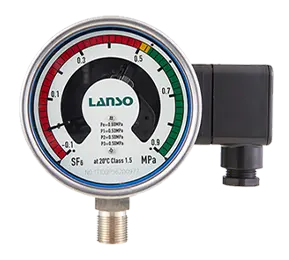
In high-voltage power systems, SF6 relays play a crucial role, used to monitor the density of SF6 gas, ensuring the normal operation of electrical equipment. However, in actual use, SF6 relays may encounter some problems. This article will discuss these problems, helping readers better understand and solve these issues.
The Effect of Gas Temperature on SF6 Relays
Gas temperature is an important factor affecting the accuracy of SF6 relays. When the gas temperature suddenly increases, what change will occur in the indication value of the SF6 relay? This depends on whether the ambient temperature of the density meter and the body temperature of the equipment's SF6 gas are consistent. If both temperatures are consistent, the indication value will remain unchanged; if there is a temperature difference, the indication value may change. Therefore, in actual applications, it is necessary to ensure the consistent temperature of the density meter and the equipment body, to improve the measurement accuracy.
The Impact of Altitude on the Readings of SF6 Relays
Altitude also has an effect on the readings of SF6 relays. For an absolute pressure type density meter, its reading is not related to altitude after inflation operation; for a relative pressure type density meter, its reading is related to altitude. Therefore, when selecting and using SF6 relays, it is necessary to consider the impact of altitude to ensure the accuracy of measurement results.
Zero Position Problem of SF6 Relays in Non-Working State
When SF6 relays are in a non-working state (i.e., not inflated), their zero position may be affected by ambient temperature. Since the pressure sensor inside the density relay measures atmospheric pressure, which does not change with temperature, but the independent action of the temperature compensation component may cause the zero position to deviate. Therefore, in non-working states, it is necessary to pay attention to the impact of ambient temperature on the zero position to avoid misjudgment.
Temperature Difference Effect During Operation of SF6 Relays
During operation, the SF6 relays, due to the temperature difference between the switch body (inside the arc extinguishing chamber) and the installation location of the density relay (possibly the mechanism box), there is a temperature difference, causing the reading of the density relay to deviate. When the temperature difference is large, it may also cause malfunctions (alarms). Therefore, during operation, it is necessary to closely monitor temperature changes and take appropriate measures to minimize the impact of temperature differences on the density relay.
How to Choose Density Relays for SF6 Gas Equipment with Low Inflation Pressure
For SF6 gas equipment with low inflation pressure, absolute pressure type density relays or density meters should be selected. This is because relative pressure type density relays are easily affected by atmospheric pressure changes under low inflation pressure, leading to inaccurate display or malfunction. However, absolute pressure type density relays are not affected by altitude and atmospheric pressure, and can accurately reflect the density of SF6 gas.
In conclusion, SF6 relays may encounter various problems during use. To ensure their accuracy and reliability, we need to deeply understand these problems and take appropriate measures to solve them. At the same time, when selecting and using SF6 relays, it is also necessary to consider the specific needs of the equipment and operating environment to ensure they can meet the actual requirements and perform optimally.